The week following Easter is a deeply spiritual time for millions around the world, culminating in a very special celebration. Officially designated as the Second Sunday of Easter, this day is now most commonly known and celebrated as the Feast of Divine Mercy.
This year, the Feast of Divine Mercy will be celebrated on Sunday, April 12th.
| Year | Date of Divine Mercy Sunday |
| 2026 | April 12 |
| 2027 | April 4 |
| 2028 | April 23 |
| 2029 | April 8 |
| 2030 | April 28 |
The choice of the first Sunday after Easter for the Feast of Mercy has a very deep theological significance, which points to the close relationship between the Paschal Mystery of the redemption and the mystery of The Divine Mercy.
The two are inseparable; the suffering and triumph we celebrate on Easter Sunday are the very mechanisms of God’s mercy. The blood and water that flowed from Christ’s pierced side on Good Friday are the source of the healing graces we are invited to receive on Divine Mercy Sunday.
The integral relationship is further emphasized by the Novena of Chaplets to The Divine Mercy which begins on Good Friday as a preparation for the Feast.
The Significance of Divine Mercy Sunday
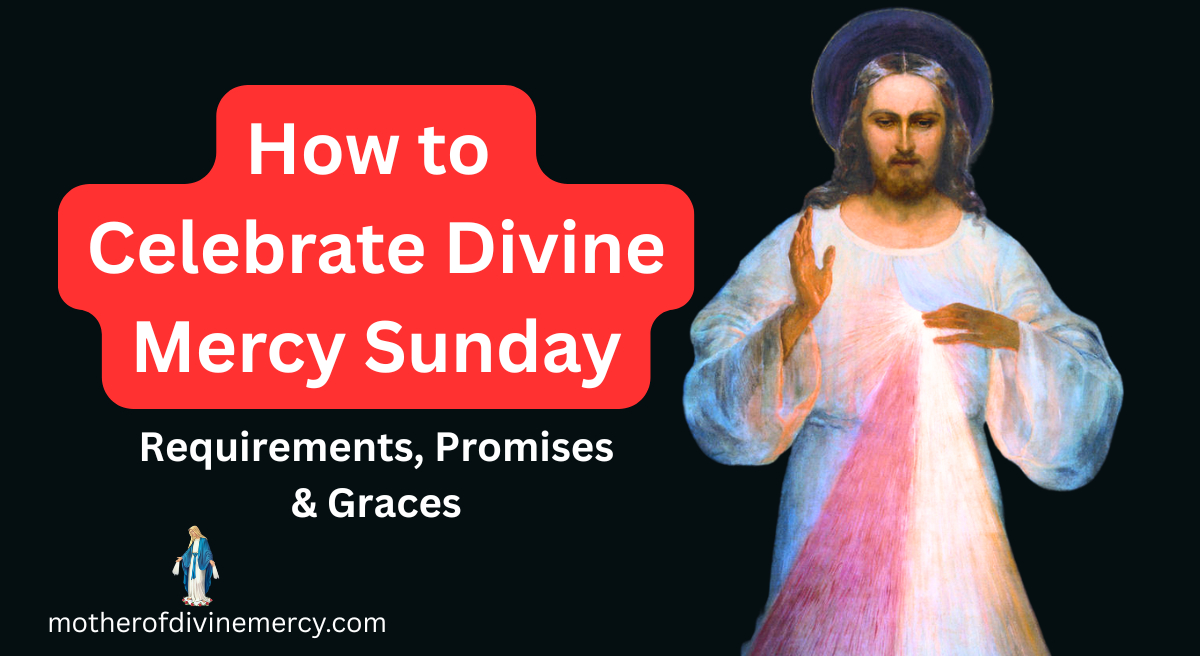
Divine Mercy feast ranks highest among all the elements of The Divine Mercy devotion revealed to St. Faustina. Its institution was requested by the Lord Jesus for the first time in Plock, in 1931, while He was communicating His will regarding the painting of the Image: “I desire that there be a Feast of Mercy. I want this image, which you will paint with a brush, to be solemnly blessed on the first Sunday after Easter; that Sunday is to be the Feast of Mercy” (Diary, 49).
The Special Grace promised by Jesus
The greatness of this feast is measured by the measure of extraordinary promises that the Lord attached to this feast: Jesus said “Whoever approached the Fount of Life on this day will be granted complete remission of sins and punishment” (Diary, 300), and also, “On this day the very depths of My tender mercy are open. I pour out a whole ocean of graces upon those souls who approach the fount of My Mercy. …… Let no soul fear to draw near to Me, even though its sins be as scarlet” (Diary, 699).
Jesus requested that a feast day be dedicated to His Divine Mercy on the Sunday after Easter. This vision was officially realized in the year 2000 when St. Pope John Paul II canonized St. Faustina and added the feast to the Church’s universal calendar.
A central theme of Divine Mercy is not just receiving mercy, but giving it. As noted in the passage from St Faustina Diary 742, Jesus told her: “I demand from you deeds of mercy, which are to arise out of love for Me. You are to show mercy to your neighbors always and everywhere.”
“I am giving you three ways of exercising mercy toward your neighbor: the first by deed, the second – by word, the third – by prayer. “In these three degrees is contained the fullness of mercy, and it is an unquestionable proof of love for Me. By this means a soul glorifies and pays reverence to My mercy. Yes, the first Sunday after Easter is the Feast of Mercy, but there must also be acts of mercy, and I demand the worship of My mercy through the solemn celebration of the Feast and through the veneration of the image which is painted. By
means of this image I shall grant many graces to souls. It is to be a reminded of the demands of My mercy, because even the strongest faith is of no avail without works.” (Diary, 742).
What to Do and How to Prepare for Divine Mercy Sunday?
If you are wondering regarding Divine Mercy Sunday what to do, the Church provides clear guidance. To receive the full graces of the day, there are specific conditions you must meet.
Here are the requirements for Divine Mercy Sunday:
- Go to Confession: You should go to the Sacrament of Reconciliation. (The Church advises that doing this within 20 days before or after the Sunday is acceptable, provided you are in a state of grace on the day itself).
- Receive Holy Communion: You must receive the Eucharist on Divine Mercy Sunday.
- Trusting in His Divine Mercy
- Pray Chaplet of Divine Mercy (optional)
Jesus explained: “No soul will be justified until it turns with confidence to My mercy; and this is why the first Sunday after Easter is to be the Feast of Mercy, and on that day, priests are to tell everyone about My great and unfathomable mercy” (Diary, 570).
The Graces and Benefits of Divine Mercy Sunday
The benefits of Divine Mercy Sunday are considered immense. According to the promises recorded by St. Faustina, the soul that goes to Confession and receives Holy Communion on this day shall obtain complete forgiveness of sins and punishment. This means you will go straight to heaven if you die after receving the graces from the feast.
The Divine Mercy Sunday blessings offer a total wiping of the slate – a profound spiritual renewal that allows believers to start fresh, washed clean by the infinite mercy of Christ.
Prayers after Holy Communion
Taking a few quiet moments after Communion to thank God for His boundless compassion is the perfect way to cap off the celebration of this incredible feast.
Prayer to Grant the Grace of feast of Divine Mercy
Lord Jesus Christ, You promised St. Faustina that the soul that has been to Confession and the soul that receives Holy Communion will receive the complete forgiveness of all sins and punishment. Please, Lord Jesus Christ, give me this grace. Jesus, I trust in You!
Anima Christi
Soul of Christ, sanctify me.
Body of Christ, save me.
Blood of Christ, inebriate me.
Water from the side of Christ, wash me.
Passion of Christ, strengthen me.
O good Jesus, hear me.
Within Thy wounds hide me.
Suffer me not to be separated from Thee.
From the malignant enemy, defend me.
In the hour of my death, call me.
And bid me come to Thee.
That with Thy saints I may praise Thee.
“Jesus, I trust in You.”
FAQs
1. Are the special graces of Divine Mercy Sunday the same as the plenary indulgence?
No, they are fundamentally different. A plenary indulgence is granted by the Church using its authority to “bind and loose.” The special graces, however, are based on a promise made directly by Jesus through a prophetic revelation to St. Faustina.
2. What do I have to do to receive the special graces?
The only requirement is to receive Holy Communion worthily on Divine Mercy Sunday (or the Vigil). This means you must make a good Confession beforehand, be in a state of grace, and place your trust in God’s mercy.
3. Do Catholics have to believe in the special graces promised to St. Faustina?
No. Because the promise is considered a private, supernatural revelation, Catholics are not strictly required to believe it as a matter of faith. However, the Church has discerned that nothing in this promise violates Catholic doctrine.
4. Do I need a perfect spiritual disposition for both?
No. You can receive the special graces even with imperfect contrition and imperfect love for God, so long as you trust entirely in His mercy. To receive a plenary (full) indulgence, however, your prescribed actions must be done out of pure love for God without any attachment to sin. If done out of fear or imperfect intentions, the indulgence is only partial.
5. Can I offer these benefits for someone else?
You can offer a plenary indulgence for yourself or for a soul suffering in purgatory. The special graces, however, can only be received for yourself through your own devout reception of Holy Communion.
6. What exactly is the “special grace” promised by Jesus?
It is the complete forgiveness of sins and all associated punishment. The special grace is described as the equivalent of a complete renewal of baptismal grace in the soul. It is spiritually equivalent to a total renewal of the grace you first received at Baptism.